

When it comes to Targets “identity loss, identity loss after divorce or career change dismantles the shared routines and plans that once structured life. Rise Thru Chaos, an ICF-trained coaching sanctuary, guides women through this post-trauma recovery. Clients rebuild a personal identity rather than passively waiting to find themselves.
Key Takeaways
Identity loss dismantles the daily routines, shared identity, and future plans that once structured a person’s world.
The body registers identity loss as a threat, producing fog, exhaustion, and free-floating anxiety.
Rebuilding identity requires active reconstruction through structured reflection, not passively waiting to find oneself.
The R.I.S.E. method guides women through four pillars: Recognize, Integrate, Strengthen, and Empower.
Why does identity loss feel so disorienting?
Identity loss dismantles the scaffolding of daily life. Divorce does not just end a marriage. It dismantles the daily routines, shared identity, and plans that structured a person’s world. One day, that individual is part of a “we” with established patterns and mutual dreams. The next day, the silence of an empty home rewrites every familiar rhythm.
The disorientation runs deeper than loneliness. A person who has lost my identity inside a partnership faces a specific kind of vacuum, often asking “who am I after divorce.” The roles of spouse, co-decision-maker, and future-planner vanish overnight. What remains is a question that echoes through every quiet moment: who am I after divorce when the mirror no longer reflects a couple?
What makes post-divorce identity loss so universal?
Hundreds of people navigating divorce report the same identity crisis. Yet few discuss it openly. The experience isolates individuals inside a private grief that feels uniquely broken. In reality, it signals a nervous system scrambling to map a world without its primary attachment figure.
How does the body respond to identity disruption?
The body registers identity loss as a threat. Familiar cues disappear. The brain’s prediction machinery fails. This neurological mismatch produces the fog, exhaustion, and free-floating anxiety that accompany major life transitions. Healing requires more than new routines. It demands nervous system regulation and trauma-informed support.
Rise Thru Chaos specializes in guiding women through identity loss and life’s most painful transitions. This is not surface-level coaching. The work addresses the embodied roots of disorientation, helping clients rebuild a self that feels authentic and whole.

What does it mean to have lost my identity?
Identity loss after divorce signals a profound disconnection from the self that existed inside the partnership. A person who defined herself through a relationship and shared achievements faces a specific kind of identity vacuum when that structure dissolves. This vacuum requires active reconstruction, not passive waiting.
The hardest part of divorce is often not losing the relationship. It is losing oneself in the version of “we” lived for years. Routines, roles, and future plans built around a partnership suddenly vanish. What remains is an unfamiliar silence and a question with no immediate answer.
Sometimes identity loss arrives quietly. A hundred small moments of feeling out of step with old choices accumulate until nothing quite fits anymore. This creeping disorientation is not a sign that something has gone wrong. It signals growth that the current life has not yet caught up to.
Why does divorce trigger such a deep loss of self?
A marriage embeds identity into daily patterns and mutual dreams. When the partnership ends, those patterns collapse. The self-concept built around being a spouse, a co-parent, or a shared decision-maker loses its anchor. Research into narrative identity confirms that women who defined themselves through partnership and achievement face a specific identity vacuum afterward.
Is identity loss a sign of emotional damage?
No. Identity loss reflects a nervous system and self-concept struggling to reorganize after seismic change. Rise Thru Chaos approaches this experience as deep emotional reclamation and nervous system healing, not surface-level coaching. The disorientation points toward transformation waiting to happen.
How can the R.I.S.E. method help me rebuild?
The R.I.S.E. method provides a structured path from survival to self-reclamation. Rise Thru Chaos designed this framework for women navigating identity loss, burnout, and post-trauma recovery. The approach combines evidence-based coaching techniques, somatic awareness, and trauma-informed care. Each phase builds on the last, creating sustainable change rather than temporary relief.
What does the first phase of R.I.S.E. involve?
The opening phase centers on recognition. Clients uncover the patterns keeping them stuck after losing their identity in a marriage or long-term partnership. Nervous system regulation happens here too. A dysregulated nervous system keeps women trapped in survival mode, unable to access clarity or make grounded decisions. This phase creates the safety needed for deeper work.
How does R.I.S.E. differ from quick-fix coaching?
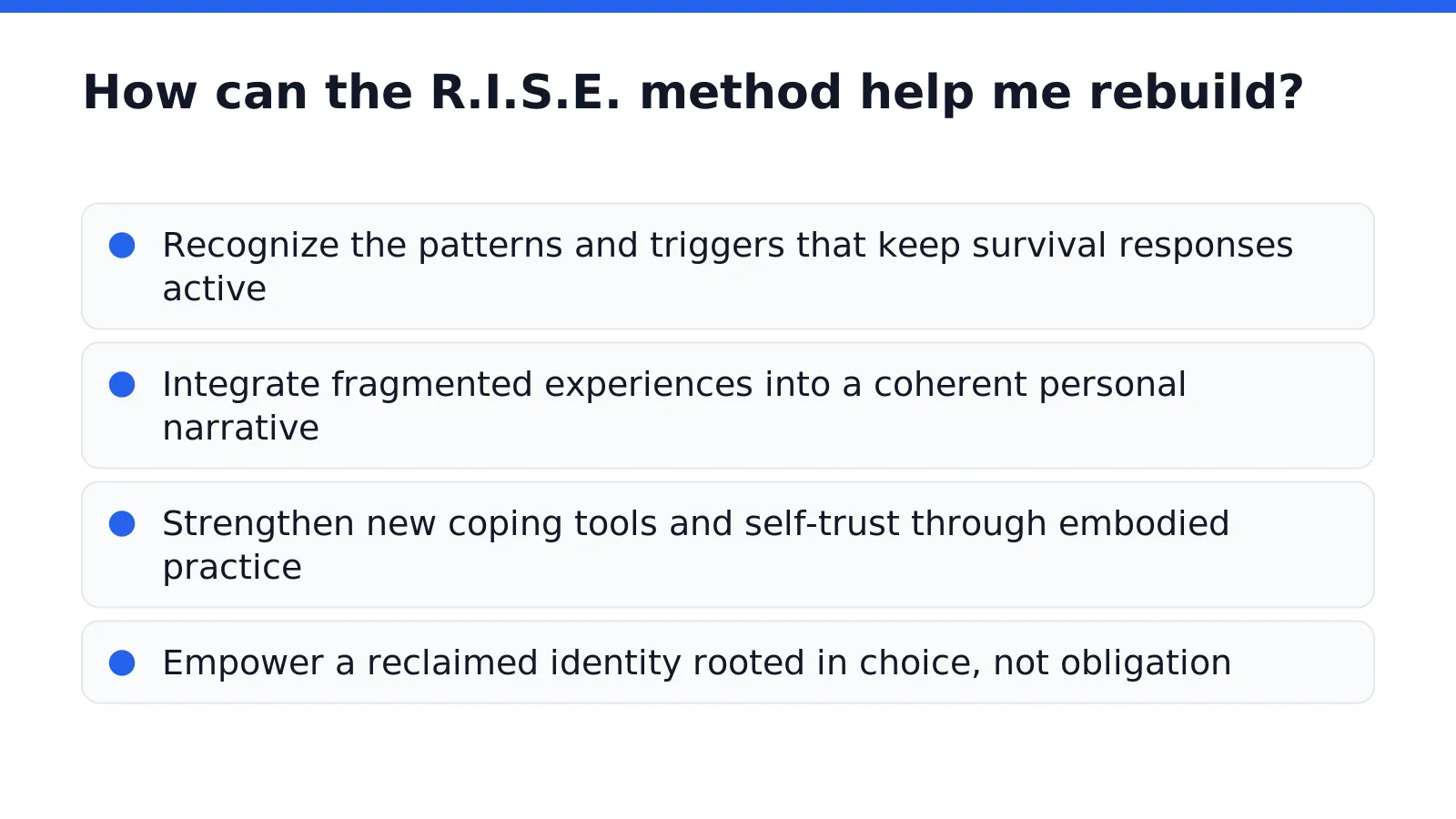
The method rejects surface-level solutions. These aren’t quick fixes; my approach combines evidence-based coaching techniques, somatic awareness, and trauma-informed care. Rise Thru Chaos offers trauma-informed coaching, somatic awareness, and emotional reclamation to help you move from survival to self-reclamation. The framework guides clients through four distinct pillars:
Recognize the patterns and triggers that keep survival responses active
Integrate fragmented experiences into a coherent personal narrative
Strengthen new coping tools and self-trust through embodied practice
Empower a reclaimed identity rooted in choice, not obligation
Each pillar honors the body, mind, and spirit. The work moves at the client’s pace, respecting the unique healing journey that follows divorce or other seismic transitions. Women asking who am I after divorce find answers through structured reflection, not forced positivity. The method meets pain with compassion while building real capacity for change.

What journaling prompts help answer who am I after divorce?
Journaling helps process the disorientation, grief, anger, and relief that surface after identity loss. A structured writing practice moves individuals from emotional chaos toward clarity. The disorientation, grief, anger, relief, or strange mix of all these emotions at once makes complete sense. The brain is processing one of life’s most significant transitions.
Rebuilding identity after divorce requires deliberate work. It is not about passively waiting to find oneself. The task involves actively rewriting a personal story. Rise Thru Chaos offers a compassionate space to explore that story and reconnect with personal truth at a comfortable pace.
What should someone write when they feel they have lost my identity?
Start with direct, honest questions. These prompts cut through the fog of confusion.
What did I enjoy doing before my marriage that I stopped?
Which values feel most true to me right now, separate from any role?
When do I feel most like myself during an ordinary day?
What am I afraid to admit I want for my future?
How does journaling connect to the R.I.S.E. method?
The coaching approach at Rise Thru Chaos meets the hard stuff with compassion and clarity. It does not bypass pain. The R.I.S.E. method guides clients through Recognize, Investigate, Shift, and Embody phases. Journaling anchors the Investigate phase. A prompt like “What story have I been telling about who I am?” reveals old narratives. Writing them down makes shifting possible. A client then embodies new truths through small daily actions.
What question reveals the self beyond the marriage?
One powerful prompt asks: “Who am I when no one needs anything from me?” This question separates identity from caregiving roles. It uncovers desires buried under years of partnership. The answer often surprises. It points toward an authentic self waiting to emerge. Trauma-informed coaching supports this exploration without judgment.
How do I start rebuilding after a career change?
Career transitions dismantle the professional identity a person has worn for years. The disorientation that follows signals growth, not failure. A person who looks at a job and feels it no longer fits has simply outgrown earlier decisions. What feels like identity loss is often the first honest readjustment toward a truer self.
What does it mean to lose yourself in your career?
The version of self tied to a title, an office, and daily routines vanishes the moment employment ends. Old coping patterns tighten their grip. Many respond by doubling down on achievement, believing harder work will quiet the internal noise. True healing requires a different approach entirely. Healing means letting go of the exhausting belief that personal worth is something earned through performance.
How does the R.I.S.E. method help reclaim identity?
Rise Thru Chaos guides women through the first phase of regeneration, helping them pause and name what they actually feel without judgment. Each service meets clients where they are and walks beside them toward wholeness. The process regenerates mental, emotional, spiritual, and physical well-being, four pillars a career change weakens simultaneously. The founder rebuilt her own life from the inside out after navigating trauma, addiction, and profound loss. That lived experience informs every session, offering clients a guide who understands the terrain firsthand.
Can you rebuild without having all the answers?
Rebuilding starts with a single honest acknowledgment: the old identity no longer fits. A journaling prompt asks clients to list three values that remain steady regardless of what job they hold. Another prompt invites them to describe the person they were before career demands took over. These small acts reconnect a person to what a career stripped away, creating space for a life that feels more fulfilling and fully their own.
FAQ
What does it mean to have lost my identity after divorce?
Identity loss after divorce signals a profound disconnection from the self that existed inside the partnership, creating a vacuum requiring active reconstruction.
Where is Rise Thru Chaos located?
Rise Thru Chaos is located in Albertville, Minnesota, US, and guides women through post-trauma recovery with ICF-trained coaching.
Conclusion
The path forward does not require having every answer today. Rebuilding identity after divorce or career change begins with one honest acknowledgment: the old self no longer fits. Rise Thru Chaos meets you in that disorientation, guiding you through structured reflection and embodied practice at your own pace. The work moves from survival mode toward a reclaimed identity rooted in choice, not obligation. You do not walk this terrain alone.
Related Posts
Why Do I Feel Numb? Understanding Emotional Numbness
Learn what emotional numbness is, why it happens, and how therapy can help…


Why Do I People Please? Breaking the Fawn Response
Understand the fawn response trauma pattern behind people-pleasing. Learn why…

Perfectionism and Trauma: Why Doing It All Isn’t Healing
Explore how perfectionism functions as a trauma response and survival strategy.…