

Setting boundaries without guilt begins with recognizing that limits protect relationships rather than damage them. Rise Thru Chaos’s trauma-empathetic coaching helps clients understand that guilt often signals old survival patterns, not wrongdoing. The R.I.S.E. method supports nervous system regulation, making boundary-setting feel safe rather than threatening.
Key Takeaways
Guilt signals an old survival pattern, not wrongdoing, when setting a boundary.
The nervous system encodes self-sacrifice as survival, triggering guilt during boundary-setting.
Micro-boundaries in safe relationships teach the nervous system that saying no is safe.
Somatic grounding after a boundary interrupts the alarm cycle and reinforces safety.
Why does setting boundaries trigger guilt?
Boundary guilt is a nervous-system alarm, not a moral failing. The discomfort traces back to emotional patterns learned early in life, long before words existed to describe them.
Many women develop beliefs that putting themselves last keeps them safe in relationships. Dr. McPhee’s clinical work reveals that these coping styles form in childhood, designed to prevent rejection or abandonment. The nervous system encodes self-sacrifice as survival. When a boundary is set, the body reacts as if danger is present. That surge of guilt signals an old protective strategy activating, not a mistake.
What happens in the nervous system when someone sets a boundary?
The brain interprets boundary-setting as a relational threat. A conditioned survival response, often fawning, kicks in automatically. The body floods with stress hormones because the nervous system learned that prioritizing personal needs risked connection. This reaction predates rational thought. It lives in the body, not the conscious mind.
How does trauma history shape boundary guilt?
Trauma rewires the nervous system to scan for threat in moments of self-advocacy. Rise Thru Chaos addresses this through trauma-empathetic coaching that targets nervous system regulation and identity rebuilding. The R.I.S.E. method supports sustainable recovery by helping clients recognize guilt as a learned alarm rather than truth. Without this reframe, guilt sabotages boundaries repeatedly. Terri Cole notes that letting guilt undermine boundaries leads straight to resentment and burnout.
Protecting peace during emotionally charged situations, such as holiday stress and family triggers, requires understanding that guilt does not equal wrongdoing. The feeling is real. The danger is not.

What do you need before setting boundaries?
Setting boundaries without guilt requires internal preparation before any words are spoken. A woman must first understand her own nervous system state and build confidence through small, safe actions. Healthy boundaries preserve connection while protecting well-being. They allow a person to show up authentically without resentment, guilt, or burnout.
Why does the nervous system matter before stating a limit?
Guilt often arrives as a nervous system alarm, not a moral failing. When someone with a history of people-pleasing or trauma considers setting a limit, the body may signal danger. Checking in with the nervous system before speaking a boundary helps distinguish between genuine threat and old survival patterns. This pause creates space for a regulated response rather than a reactive one.
How do micro-boundaries build confidence?
Starting with micro-boundaries, low-stakes refusals in safe relationships, builds the skill without overwhelm. A woman might decline an extra task from a supportive friend or delay responding to a non-urgent message. These small wins teach the nervous system that saying no does not lead to catastrophe. Each successful micro-boundary strengthens the foundation for harder conversations later.
The preparation phase matters as much as the boundary itself. A regulated nervous system and practiced small refusals transform boundary-setting from a terrifying confrontation into an act of self-honoring.
How do you set boundaries without guilt?
Setting boundaries without guilt requires a shift from emotional reaction to intentional communication. How to set boundaries without guilt begins with recognizing that guilt often functions as a nervous-system alarm rather than evidence of wrongdoing. The discomfort signals a learned pattern, not a moral failure. Practical skills from Acceptance and Commitment Therapy (ACT) and Dialectical Behavior Therapy (DBT) provide the foundation for communicating limits clearly, kindly, and effectively.
What are boundary scripts and why do they work?
Boundary scripts are pre-planned phrases that remove the cognitive load from difficult conversations. Explain why guilt shows up as a nervous-system alarm, then give six scripts and what to do when people push back. Link to Week 1 so the two posts These scripts act as personal rules of engagement. They let others know what is acceptable and what crosses a line. A script bypasses the freeze response that hijacks clear thinking during confrontation. The structure keeps communication direct, compassionate, and free of over-explanation.
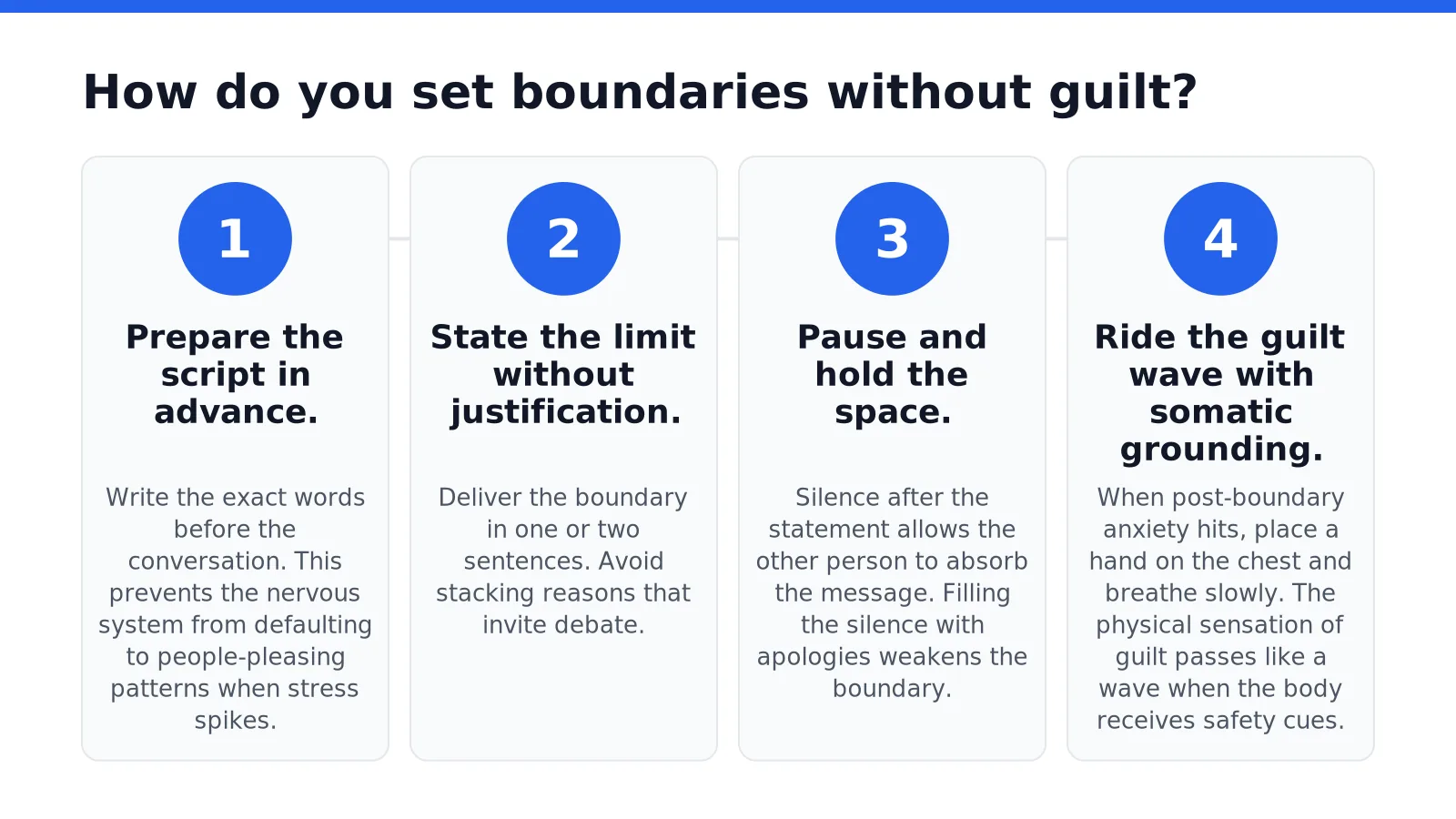
Prepare the script in advance. Write the exact words before the conversation. This prevents the nervous system from defaulting to people-pleasing patterns when stress spikes.
State the limit without justification. Deliver the boundary in one or two sentences. Avoid stacking reasons that invite debate.
Pause and hold the space. Silence after the statement allows the other person to absorb the message. Filling the silence with apologies weakens the boundary.
Ride the guilt wave with somatic grounding. When post-boundary anxiety hits, place a hand on the chest and breathe slowly. The physical sensation of guilt passes like a wave when the body receives safety cues.
How does guilt function as a nervous-system alarm?
Guilt after setting a boundary activates the same threat-response circuitry as physical danger. The brain interprets potential rejection or conflict as a survival risk. This reaction traces back to early emotional patterns where compliance ensured safety. Recognizing guilt as a conditioned alarm separates the feeling from the decision. The boundary remains intact while the body processes the discomfort. Somatic grounding interrupts the alarm cycle and teaches the nervous system that limits are safe.
What if people push back on your boundaries?
Pushback signals a boundary is working. The other person’s discomfort does not mean the boundary was wrong. Navigating pushback requires staying grounded without collapsing or counter-attacking.
Some people test limits because they benefited from the old dynamic. Their reaction reflects their own discomfort, not a failure on the boundary-setter’s part. Letting guilt sabotage boundaries leads to resentment and burnout. Terri Cole describes this pattern as a one-way ticket to Bitter Town.
How does someone stay grounded when a boundary is challenged?
A calm, repeated statement works better than explaining or defending. The individual pauses, takes a breath, and restates the boundary using the same boundary scripts from earlier practice. Silence after the restatement creates space. The other person’s emotional reaction belongs to them.
What helps with the vulnerability hangover after setting a limit?
Handling the internal aftermath involves self-compassion practices for the vulnerability hangover. The nervous system often interprets old patterns as safety. Breaking those patterns triggers alarm. Acknowledging the discomfort without judgment allows it to pass. Trauma-empathetic coaching helps women reclaim their lives and return to their power through nervous system healing and emotional reclamation. Rise Thru Chaos Coaching & Wellness guides clients through this exact process, meeting the hard moments with compassion rather than bypassing them.
How can coaching help you maintain boundaries?
Trauma-empathetic coaching helps clients maintain boundaries by addressing the nervous system patterns that trigger guilt. Rise Thru Chaos guides women through post-trauma recovery, burnout, and identity loss with a compassionate, structured approach. The work goes deeper than surface-level advice. It targets the root causes of boundary collapse.
Why does guilt show up when setting boundaries?
Guilt often signals a dysregulated nervous system, not a moral failure. For many women, early survival patterns taught the body that saying no meant risking rejection or abandonment. Coaching helps clients recognize this alarm for what it is. A protective mechanism, not a truth.
What happens in a coaching session focused on boundaries?
Sessions blend emotional processing with practical skill-building. The R.I.S.E. method supports nervous system regulation and identity rebuilding, creating lasting change rather than quick fixes. Clients learn to notice when old patterns activate. Then they practice responding differently.
The process follows a clear sequence:
Identify the physical sensations that accompany boundary guilt.
Name the underlying fear without judgment.
Practice a boundary script that honors personal capacity.
Process the emotional aftermath with compassionate support.
Rise Thru Chaos meets the hard stuff with compassion and clarity. The coaching relationship provides a safe space to move through discomfort. Honoring personal capacity at a sustainable pace becomes the foundation for every boundary set. This approach transforms boundary work from a source of anxiety into an act of self-reclamation. Clients discover that maintaining limits strengthens relationships rather than damaging them. The body learns a new truth: safety exists on the other side of a firm, kind no.
FAQ
Why does setting boundaries trigger guilt?
The discomfort traces back to emotional patterns learned early in life.
### How does trauma history shape boundary guilt?
Rise Thru Chaos addresses this through trauma-empathetic coaching targeting nervous system regulation.
Conclusion
Boundary guilt is a conditioned alarm, not a truth. Each time you hold the limit and ride the wave with somatic grounding, your nervous system learns that safety exists on the other side of a firm, kind no. The scripts give you the words; the practice rewires the response. Your next step is to choose one script and speak it today, trusting that the discomfort passes and the boundary stays.
Related Posts

Holiday Stress and Family Triggers: How to Protect Your Peace
Navigate holiday triggers and family conflict with trauma-informed coaching.…


Why Do I Feel Numb? Understanding Emotional Numbness
Learn what emotional numbness is, why it happens, and how therapy can help…
Why Can’t I Relax? Understanding Hypervigilance
Hypervigilance locks the nervous system in survival mode after trauma. Learn…